

A New Home
You won't know what you want until you're free to build it wrong


I’ve published two websites in the last three years.
The first one looked like every other personal website. Clean layout with an about section. Simple. Professional.
The second one tried harder. Better design. Clearer sections. All my published work in one place.
Unfortunately, neither felt like mine.
Each time I looked at them, I wondered why they felt off. The structure made sense. The design worked. But something was missing.
It took building the third one from the ground up to realize what it was.
Few weeks ago, I started vibe-coding a new website.
I didn’t use a template or a drag-and-drop developer. Just Claude Code, a blank canvas, and dozens of decisions I’d never had to make before.
The first thing I worked on was a home page and navigation bar. Simple enough. But what goes in it?
With a template, that’s already answered. On the home page: who you are, what you do, and a picture of yourself. As for the nav bar, an about, work, and contact subpages.
The same layout and sections every website has.
Without one, I had to choose for myself: what do I actually want people to see?
The first website felt like the kind of thing that was made to impress.
The second website turned out to be a library where everything’s catalogued but nothing’s alive.
This one is different. It’s unfinished. I care less about it looking professional and more about it feeling honest. There are sections I’ll revamp and parts that don’t work yet. But it’s simple and has a few neat features that best represent who I am and how I think.
It’s mine in a way the others never were.
Here’s a quick preview:
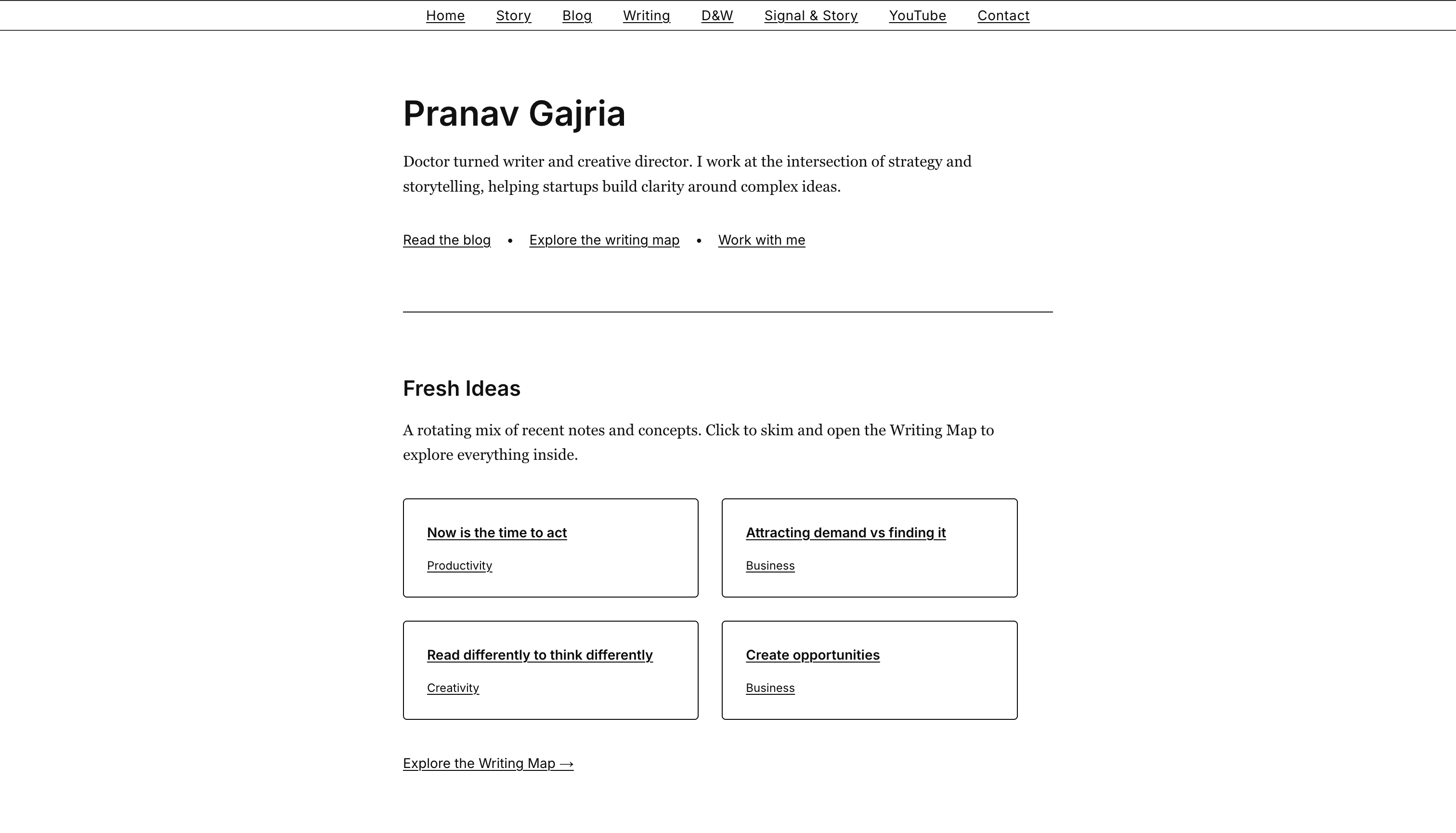
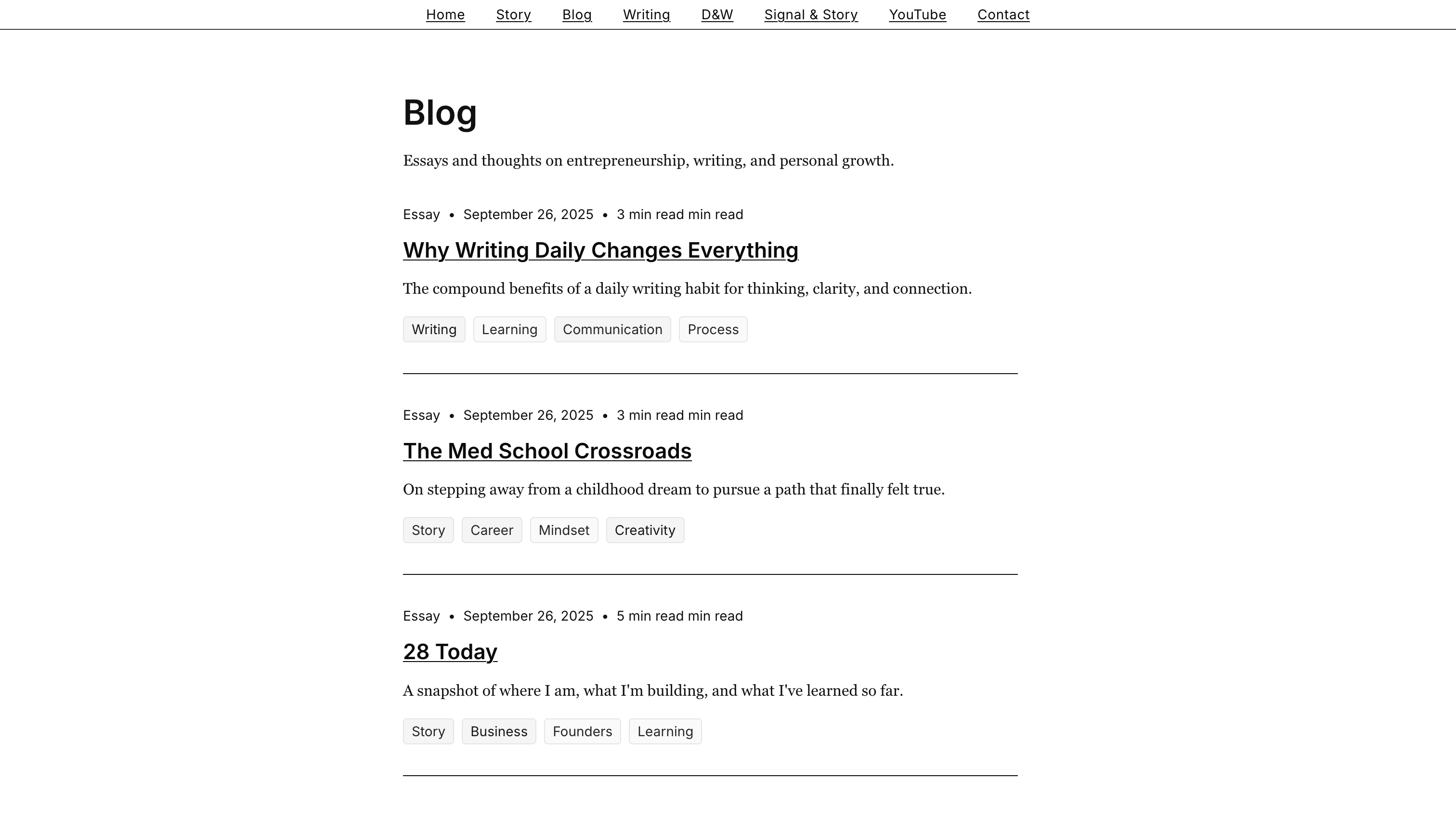
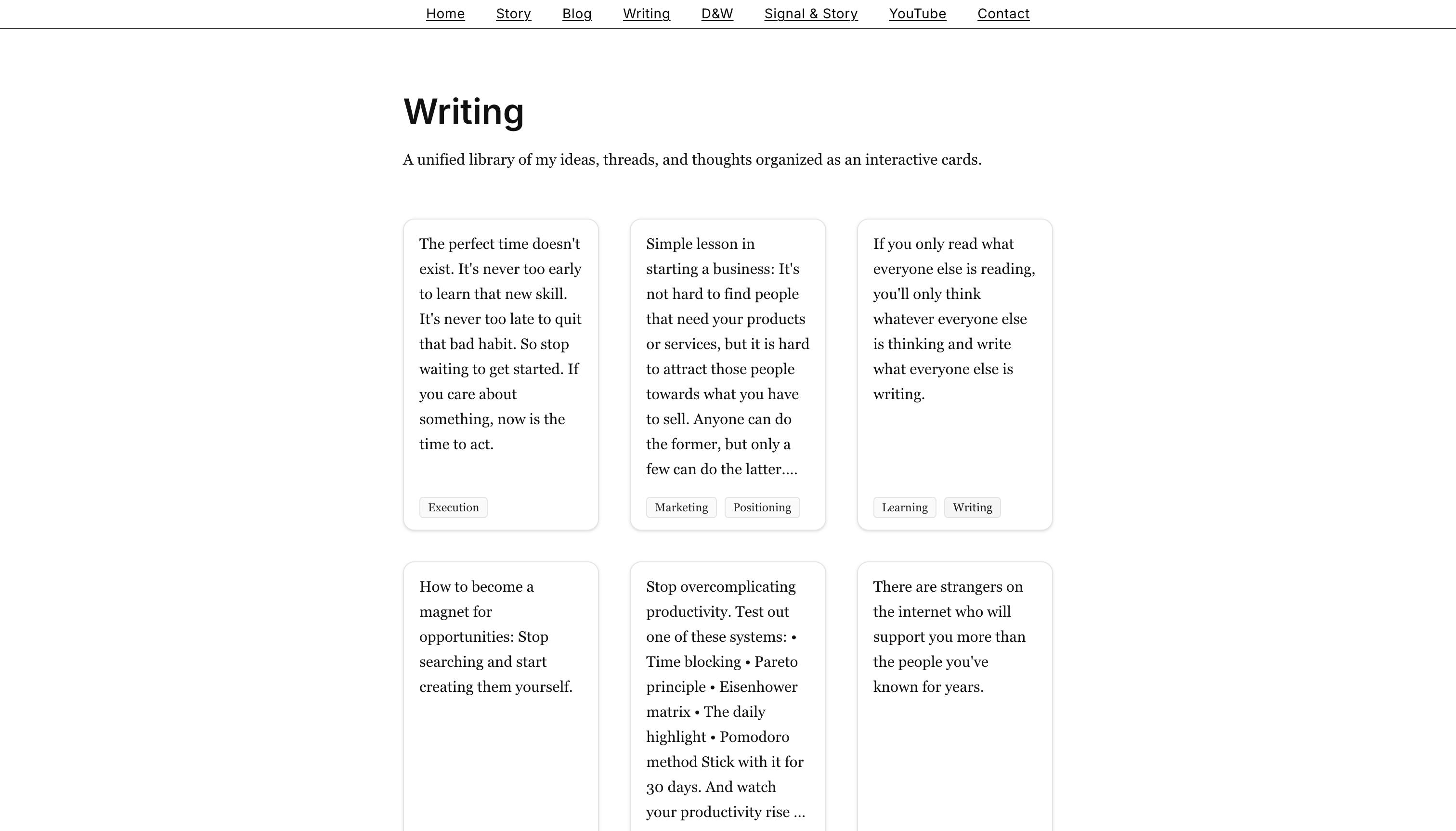
You won’t know what you want until you have the freedom to build it wrong.
When you work with a template, someone else has already decided what matters, where things go, and how they should flow. When you start from scratch, every decision gets you closer to figuring out what you actually want.
In fact, most of us build in spaces designed by someone else. Social media profiles, portfolio sites, and digital platforms — all come with their own predetermined layouts. You can publish content and maybe tweak a few colors, but you’re always working within someone else’s structure.
It’s like renting an apartment. You can rearrange the furniture, hang some pictures, make it comfortable. But the walls are where someone else placed them, and you have to constantly adjust yourself to fit the space.
Building brick by brick is slower. Messier. You learn things you didn’t know before. Make decisions you’re not sure about. But you end up with something made your way that’s truly yours.
I’m taking one step back to take three steps forward.
I could’ve launched weeks ago with a template. But I wouldn’t know what’s possible until I stopped following instructions. I wouldn’t have had proof that I can build something from nothing.
The website isn’t done just yet. There are pages I need to scope and sections that need a lot more work. But that’s the point.
The best way to figure out what you want to make is to build something first, figure out what’s wrong, and then build once again.
What’s one thing you’ve built that taught you something you didn’t expect?
Hit reply and let me know. I’d love to hear from you.
— Pranav
P.S. The website will be live soon. When it is, you’ll be the first to see it.
Special thanks to Louie Bacaj, Chao Lam, and Chris Wong, for the push to make this project a reality!
I'm both drawn to the idea of building things from scratch and also very daunted by the idea due to the time involved. There are tradeoffs either way. I built an app with a developer last year from scratch and it was one of the most fun, challenging, time-consuming, expensive and satisfying creative projects I've ever undertaken. I learned it's WAY harder than I imagined to build a tool and platform that is understood by everyone. User testing revealed that everyone thinks SO differently. You can put a big button that says "Start Here" smack in the middle of the page and you'll still get people saying, "I'm confused, what do I do next?" It ultimately drove home the diversity of intelligent humans and the different ways we think.